Observe
Collect successful linearized traces from agents and workflows.
ICML 2026 Poster Companion · COEX Seoul
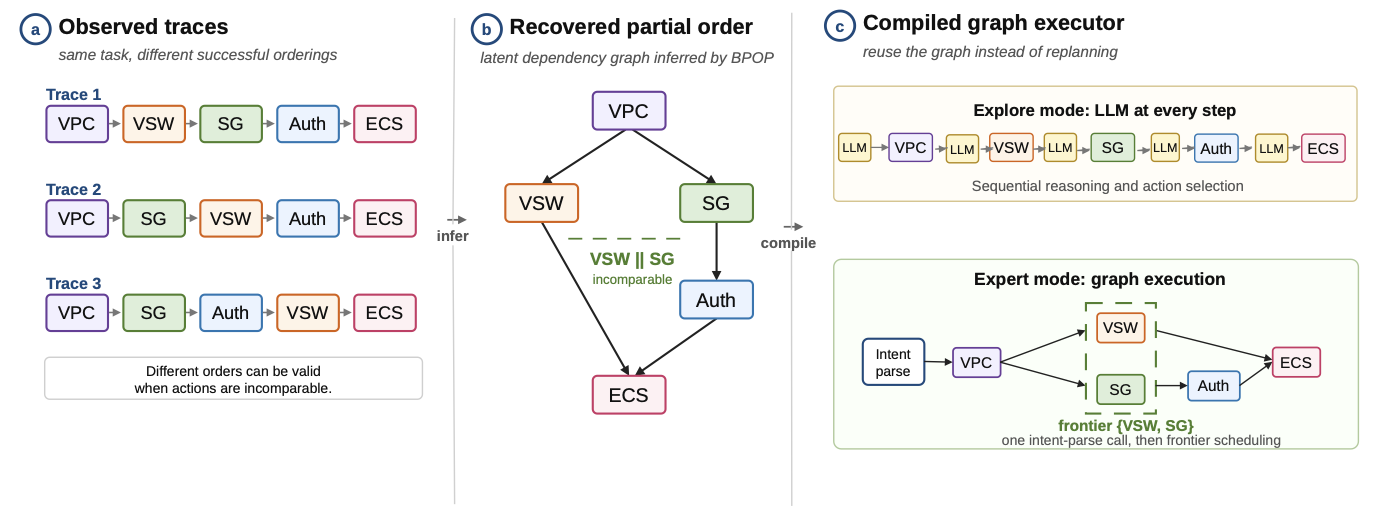
Linear agent traces are noisy serializations, not workflows. BPOP recovers the latent executable partial order and compiles it into efficient frontier execution.
Trace Puzzle
In a single-threaded log, independent actions must still appear in some order. When the same task succeeds with both orders, BPOP treats the disagreement as evidence for concurrency.
Pair evidence
Both relative orders appear in successful traces, so the pair is treated as incomparable rather than a hard dependency.
Method
BPOP is an offline workflow-compilation step. It learns a reusable dependency abstraction from historical successes, then uses that graph to avoid repeated per-step LLM planning.
Collect successful linearized traces from agents and workflows.
Use a frontier-softmax likelihood over feasible actions instead of marginalizing over all linear extensions.
Convert posterior edge probabilities into a frontier-based graph execution engine with fallback when needed.
Cloud-IaC Replay
The local demo uses precomputed scenario graphs from the paper. It is designed as a stable conference replay, not a live cloud API run.
Nodes in the frontier are feasible because all prerequisites have already completed.
Results
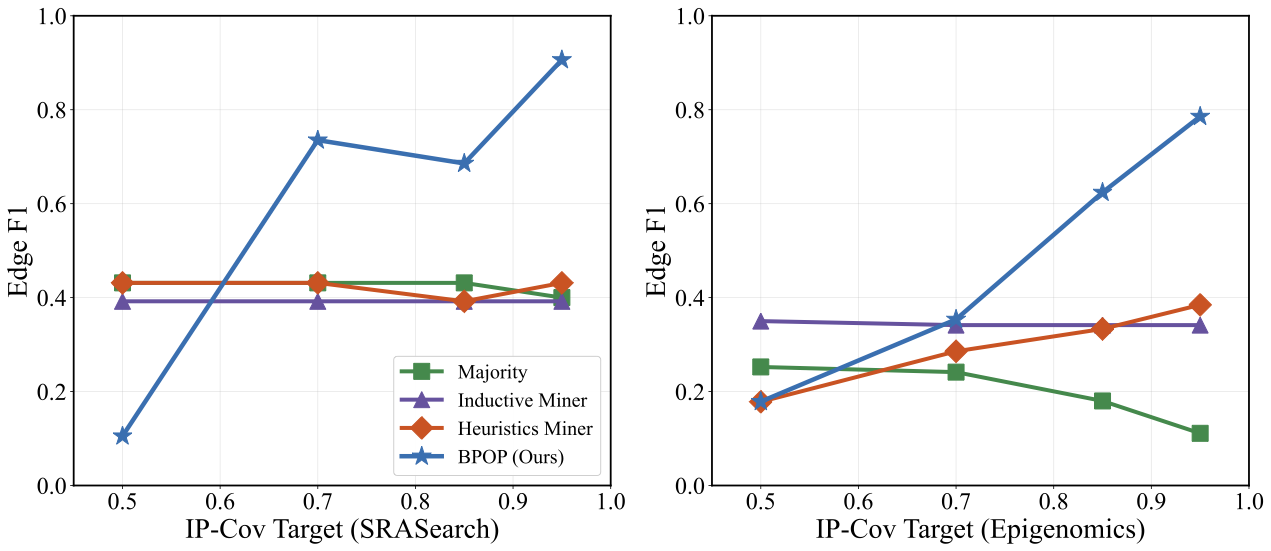
Once diverse traces expose enough incomparable pairs, BPOP recovers a high-quality graph and fallback reasoning collapses.
| Mode | Success | Avg tokens |
|---|---|---|
| Expert | 66.7% | ~583 |
| Hybrid | 100.0% | 13,234 |
| Explore No CoT | 50.0% | 38,999 |
| Explore CoT | 66.7% | 63,632 |
On WFCommons, BPOP recovers scientific workflow structure with Edge-F1 0.91 on SRASearch and 0.79 on Epigenomics while preserving execution validity.
Compilation Safety
Extra edges reduce parallelism but remain safe. Missed dependencies can trigger premature execution, missing inputs, or runtime failure.
Around alpha = 1/3, compilation keeps a conservative bias toward dependency recall while preserving useful concurrency.
Resources
The website is built as a static poster companion, so these links can be mirrored directly to OSS static hosting.
@inproceedings{li2026delinearizing,
  title={De-Linearizing Agent Traces: Bayesian Inference of Latent Partial Orders for Efficient Execution},
  author={Li, Dongqing and Cheng, Zheqiao and Nicholls, Geoff K. and Kong, Quyu},
  booktitle={Proceedings of the 43rd International Conference on Machine Learning},
  year={2026}
}